For years, one of the safest strategies in Builders’ Merchanting was to do nothing.
If the branch was profitable, sales were growing, the yard was busy and customers kept coming back, why change anything? Why invest significant sums in technology, disrupt processes that work perfectly well or risk alienating loyal customers who liked things the way they were? It was a perfectly reasonable approach.
However, the world around Home Improvement Retailers and Builders Merchants is now changing considerably faster than the branches themselves. Customer expectations are shifting, a new generation of tradespeople have entered the industry, technology is developing at extraordinary speed, and convenience
has established itself as a fundamental part of any commercial strategy.
Throw Artificial Intelligence and Agentic Commerce into the mix and the pace of change will only accelerate. Against that backdrop, standing still is no longer the safe option it once appeared to be. Increasingly, doing nothing is a strategy in itself and potentially the riskiest one of them all.
Forced, Chosen or Inspired
There is a simple way of thinking about organisational change that I’ve always liked. Businesses generally change for one of three core reasons. They are forced to change, they choose to change, or they are inspired to change because they see a better way.
The first is by far the most uncomfortable. When a business is forced to change, the warning lights have usually been flashing for some time. Sales have fallen, customer numbers have declined, margins have deteriorated or a competitor has changed the local market. At that point, change is no longer strategic, it becomes
necessary.

Choice is very different; it means recognising that the world around you is changing while your business is still performing well and having the confidence to act before you need to.
Then there is inspiration. Seeing what Screwfix has done with convenience, Uber with visibility, supermarkets with Click & Collect or what AI is beginning to do with customer service and asking: Could we do that? The smartest businesses rarely wait until they are forced to change; in fact, the best time to change a business is probably when you don’t have to.
The Danger of Being Comfortably Successful
Poorly performing businesses generally know they have a problem, as declining sales, margin and customer numbers tend to focus the mind. The potentially more dangerous position is being comfortably successful. The branch is profitable, customers continue to arrive and relationships remain strong. There’s no obvious burning platform and therefore little urgency to change.
But the P&L tells you what happened last year, it doesn’t necessarily tell you what your customers will expect tomorrow.
Customer behaviour often changes long before the financial impact becomes visible. By the time declining sales appear on the management report, customers may already have established newhabits elsewhere.
A successful retailer or Builders Merchant has the time and resources to experiment, test new ideas and introduce change gradually, whereas a struggling business has considerably fewer options.
Convenience Has Changed the Benchmark
I’ve written previously in The Hardware Journal about convenience becoming the latest battleground for merchants, and I remain convinced this is one of the biggest changes taking place in our sector. The tradesperson’s most valuable commodity is increasingly not cash, but time. Every unnecessary journey, unavailable product, queue at the counter, inaccurate delivery window, incorrect
delivery or complicated payment process wastes something they can never get back.
Trade customers no longer benchmark their merchant experience purely against another merchant. Amazon tells them when their parcel will arrive, supermarkets allow them to order at midnight and collect the following morning, while Uber shows them precisely where their driver is.
Real-time stock visibility, simple ordering, rapid Click & Collect, extended-hours collection, accurate delivery information and frictionless payment are rapidly moving from differentiators to expectations. Convenience doesn’t necessarily mean doing everything faster; it means removing unnecessary effort from the trade customer’s working day.
Two Customers, One Branch
The traditional trade customer isn’t disappearing. Many tradespeople value personal relationships, knowledgeable staff and the ability to walk into a branch and speak to someone who understands their business. That remains an enormous strength of the best merchant branches across the United Kingdom and Ireland.
But alongside that customer is a younger generation who have grown up ordering through apps, checking availability online and expecting information instantly. One customer may want to ring the branch at 7.30am to see if an item is in stock. Another wants to order it at 10.30pm the night before, pay through their phone and collect at 6.30am without speaking to anybody.
Neither customer is wrong: the challenge for the merchant branch of today is being brilliant at serving both.
What Does Doing Nothing Cost?
Whenever businesses consider change, they naturally focus on the cost. How much will it cost? What’s the return on investment? How disruptive will implementation be? What happens if it doesn’t work? These are perfectly legitimate questions, but there is another side of the calculation which receives far less attention and that is: What is the cost of doing nothing?
What does another year of inaccurate stock information cost in lost sales? What do unnecessary queues cost? What does inefficient delivery planning cost? What does having experienced employees spending hours on tasks that could be automated cost?
And perhaps most importantly, what does gradually becoming less relevant to the next generation of trade customers cost? Those numbers rarely feature on a spreadsheet, but that doesn’t mean they don’t exist.
Evolution, Not Revolution
None of this means ripping everything up and starting again. The better approach in this world of constant change is continuous improvement, focusing on areas of friction and removing them one step at a time.
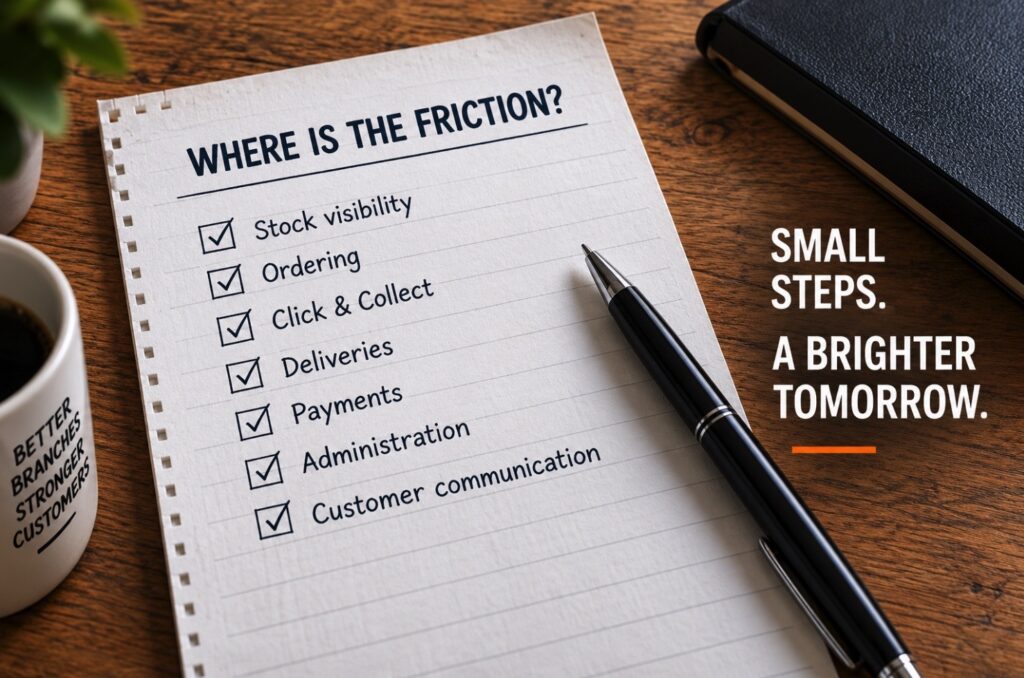
Where are customers wasting time? Where are colleagues duplicating effort? Where is information difficult to access? Where are processes designed around how the merchant has always operated rather than how the customer increasingly wants to buy?
You simply need to make tomorrow’s branch slightly better than today’s.
The Bottom Line
I remain incredibly optimistic about the future of the builders’ merchant sector. There is something uniquely powerful about combining physical stock, local availability, knowledgeable people and long-standing customer relationships. But believing in the future of the branch shouldn’t be confused with believing that the branch doesn’t need to change.
Which brings us back to those three reasons businesses change. You can be inspired to change, because you’ve seen a better way. You can choose to change, while the business is successful and you have the time and resources to get it right. Or eventually, you can be forced to change, because customers, competitors or the market have made the decision for you.
The successful merchants won’t necessarily be those making the biggest investments or adopting every new technology before anyone else. They’ll be the businesses constantly asking where friction exists, what their customers increasingly expect and what they could do better.
Because in a market moving this quickly, there will always be risks associated with making the wrong decision. But increasingly, the biggest risk of all is making no decision at all.
Steve Collinge is an international speaker, influencer, retail commentator and executive editor of Insight DIY. You can follow Steve on LinkedIn.