There is a growing contradiction inside modern DIY and Garden stores. Across the sector, retailers are talking more than ever about inspiration, customer experience and the need to create engaging shopping environments. Conversations about younger homeowners, social media influence, lifestyle merchandising and experiential retailing are now commonplace and customer expectations around home and garden retailing have shifted significantly over the past decade. And yet, despite all of this, the reality inside many DIY stores remains remarkably familiar.
Large-format environments are still heavily organised around system-driven product categories rather than customer projects. Shopping journeys continue to reflect operational structures-built decades ago, with layouts designed primarily around replenishment efficiency, category management and internal retail logic rather than how customers actually approach projects to improve their homes and gardens.
The challenge facing DIY and Garden retail is an extremely difficult one. Physical retail is expensive to change properly, reconfiguring store layouts, redesigning customer flow, moving major categories and rebuilding operating models involves significant investment, with questionable return on investment, huge disruption and commercial risk.
As a result, many retailers have understandably focused on improving the visual layer of the store without fundamentally changing the structure underneath it. The consequence is that many DIY and Garden stores today have become cosmetically more inspirational without becoming structurally any easier to shop.
Displays may look more contemporary, decorating departments may feel more aspirational and outdoor living areas may appear more lifestyle-led, but the customer journey underneath often remains fragmented, unnecessarily complicated and often broken. Increasingly, that really matters because customers themselves are changing.
Customers think in projects
The modern DIY customer does not think in categories. Customers do not wake up on a Saturday morning thinking about paint aisles, decorating accessories, adhesives or lighting departments. They think about transforming a spare bedroom into a home office, modernising a tired kitchen or redesigning an outdoor space for entertaining friends and family.
Their thinking is emotionally driven, project-focused and outcome-led. The problem is that many stores are still organised around how retailers manage products and categories internally, rather than how customers manage projects; and that disconnect is becoming one of the defining challenges facing the sector.
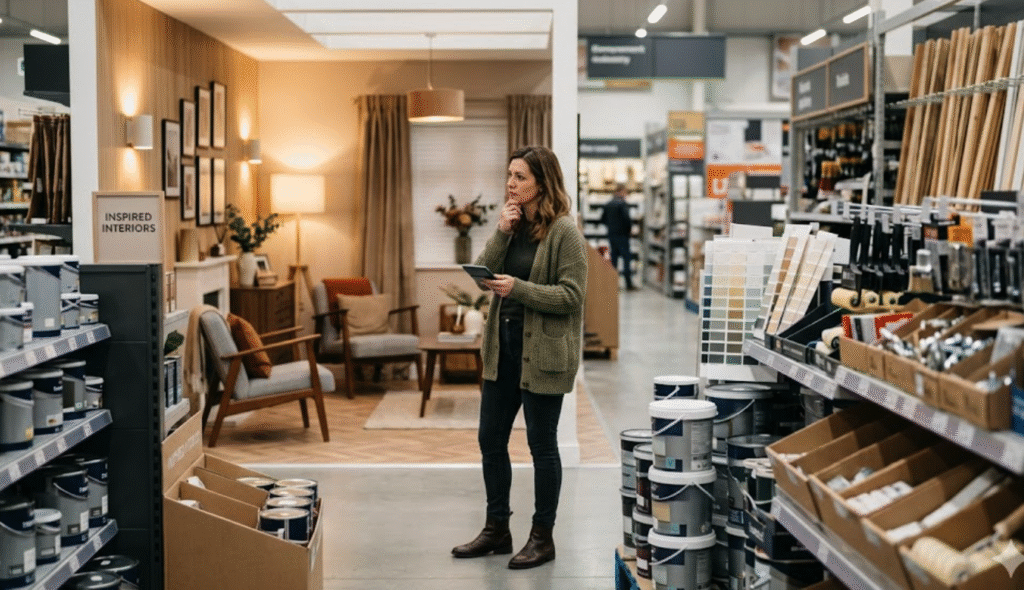
The inspiration economy
One of the biggest shifts affecting DIY and Garden retail is that inspiration and influence increasingly happens long before the customer enters the store. Platforms such as Instagram, TikTok and Pinterest have fundamentally changed how consumers engage with home and garden improvement. Customers now spend huge amounts of time-consuming aspirational content, watching room and garden transformations, following influencers renovation journeys and building highly curated visions of how they want their own homes and gardens to look and feel.
In many ways, home and garden improvement retail has become part of a broader inspiration economy.
Historically, DIY retail was often functional and always necessity driven. Customers visited stores because something needed repairing, replacing or maintaining. Today, however, many projects begin with aspiration rather than necessity. Consumers are not simply purchasing products; they are buying into an idea of a lifestyle, an aesthetic or a version of their home that feels more contemporary, personal and emotionally rewarding and this has fundamentally changed the role of the store.
Customers increasingly arrive at the store already inspired. They have seen the colours they like; the wall finishes they want and the room concepts they aspire to recreate. Their expectations have been shaped not only by other retailers, but by interiors brands, boutique furniture retailers, social media creators and digitally native lifestyle businesses that understand visual storytelling exceptionally well.
As a result, DIY retailers have been forced to respond by improving presentation standards, investing in stronger merchandising and introducing more inspirational displays and room sets. In some areas of the market, particularly decorating and outdoor living, genuine progress has been made.
However, while retailers have become better at creating aspiration, many still struggle to support what comes next, and that is where the real problem begins to emerge.
Beautiful displays, weak conversion
One of the most interesting developments within DIY & Garden retail over recent years is the growing gap between inspiration and conversion. Retailers have become increasingly skilled at creating visually engaging environments: contemporary room sets, coordinated merchandising and lifestyle-led displays undoubtedly help capture customer attention and create emotional engagement.
Customers can now more easily visualise what products may look like inside their own homes, which is an important step forward for the sector, but visual inspiration alone does not necessarily complete a sale.
In many stores, customers still encounter operational friction almost immediately after the moment of inspiration. A beautifully merchandised room set may successfully create aspiration, but if the journey that follows feels confusing, frustrating or intimidating, conversion begins to weaken very quickly.
This becomes particularly evident within categories such as decorating, bathrooms and kitchens, where the visual presentation of the finished result has improved dramatically, while the practical execution journey often remains overly complex.
A customer may stand in front of a contemporary room display featuring acoustic wall panels, coordinated paint tones, decorative lighting and carefully selected accessories and immediately imagine something similar within their own home. Emotionally, the display has done its job extremely well.
The difficulty begins when the customer tries to move from aspiration to action. Questions quickly emerge around product location and availability, installation complexity, required tools, preparation materials and overall project confidence. Customers begin trying to calculate how products fit together, whether they are capable of completing the work themselves and what happens if mistakes are made along the way. At this point, the emotional momentum and motivation created by the display quickly begins to erode.
The sector often underestimates how intimidating DIY projects can feel for less experienced consumers. Unlike many other forms of retail, home improvement carries perceived risk. Customers worry about wasting money, damaging their homes, buying incorrect products or starting projects they may not be capable of finishing successfully. This is why inspiration without enablement can sometimes create anxiety rather than conversion.
The confidence gap
Modern consumers are often highly motivated to improve their homes, but significantly less confident in their practical ability to execute projects themselves. Social media has democratised inspiration far more quickly than practical capability. As a result, many customers now arrive inspired but uncertain, ambitious but anxious.
This profoundly changes the role of DIY and Garden Retail. Increasingly, customers are not simply shopping for products. They are searching for reassurance, clarity and confidence that a project is achievable. In many ways, confidence has become one of the most commercially important assets inside modern retail because confident customers begin projects while uncertain customers often postpone them indefinitely.
Retailers therefore face a very different challenge from the one they faced twenty to thirty years ago. Historically, the objective may have been to provide range, availability and competitive pricing. Today, however, retailers must also simplify complexity, reduce customer anxiety and make projects feel achievable for less experienced audiences. And many current store environments are simply not designed around those objectives.
Why friction still exists
Most stores still fundamentally operate around disconnected product categories that reflect internal retail structures rather than customer journeys.
Customers are often required to move between multiple departments, mentally connecting products, accessories and materials together themselves in order to complete even relatively straightforward projects.
For example, think of a Decking Project. The basket of products required to complete the project are rarely located together: the decking planks in the outdoor timber area, the screws, lighting and decking stain each located in completely separate parts of the store. The customer inspired by the Decking display is suddenly required to navigate exterior paint departments, hardware, building, lighting and installation materials spread across multiple disconnected areas of the store.
The burden of assembling the project effectively falls onto the customer themselves and in many cases, the customer becomes the systems integrator.
This creates friction, uncertainty and cognitive overload at precisely the point where retailers should be building confidence and momentum.
This is particularly important because home improvement projects carry emotional pressure that many other retail categories simply do not. A poor purchase decision in fashion retail may result in returning an item. A poor decision in DIY retail can potentially lead to wasted weekends, damaged homes, unfinished projects and significant financial frustration.
Retailers that fail to understand this psychology risk creating stores that inspire visually while intimidating operationally.
The next battleground
The retailers that succeed over the next decade will not simply be those with the most visually impressive displays or the broadest ranges. They will be the businesses that most effectively simplify projects, reduce customer anxiety and create confidence throughout the shopping journey.
The DIY store will not ultimately be defined by how inspirational it looks; it will be defined by how effectively it helps customers move from aspiration to execution and that represents a profound shift for the sector.
- From product-led retail to project-led retail.
- From operational efficiency to customer enablement.
- From simply selling products to actively removing uncertainty.
The retailers that thrive over the next decade are unlikely to be those with simply the largest ranges or biggest stores. They will be the retailers that best connect inspiration with execution and make home improvement projects feel achievable rather than intimidating. Because in the end, customers are not really buying paint, tools or wall panels, they are buying the confidence to transform their homes.
Steve Collinge is an international speaker, influencer, retail commentator and executive editor of Insight DIY. You can follow Steve on LinkedIn and X.