Report by Thierry Coeman on the Global DIY Summit: Did the industry live up to its ambition?
Lisbon, the Queen of the Sea, once launched fleets to discover new continents. In June 2025, it once again served as a global launchpad, not for ships, but for transformable ideas, at the 11th Global DIY Summit, themed: “A New World Order: Redefining DIY for a Global Future.”
The title was ambitious, even provocative. It hinted at disruption, reinvention, and bold transformation. From a marketing perspective, the theme promised a lot, and with high promise comes even higher expectations.
So, the question stands: did the content and delivery of this landmark event match its bold mission?
Blue Oceans and Bold Visions
The theme naturally evokes the Blue Ocean Strategy, the seminal business concept introduced two decades ago by W. Chan Kim and Renée Mauborgne. The strategy urges companies to abandon cut-throat competition in saturated “red oceans” and instead pursue uncontested market spaces, “blue oceans”, where disruption and innovation thrive.
In the context of DIY and home improvement, this means escaping the gravitational pull of price wars and commoditisation. It calls on businesses to redefine themselves, not as cost leaders, but as creators of unique, meaningful solutions that merge innovation, creativity, and technology to serve evolving consumer needs.
Lisbon, then, was aptly cast as both host city and metaphor: a gateway to transformation, where the tides of the industry might just shift toward a more visionary horizon.
A Summit framed by insight
A few standout speakers embraced the full magnitude of the summit’s theme and offered substantive frameworks to navigate these uncharted waters.
Professor Sony Kapoor, from the European University Institute and the London School of Economics, delivered a powerful opening that laid the philosophical and economic foundation for transformation.

His message was simple yet profound: “All progress originates from two core drivers, natural resources and human capital.” By interpreting today’s challenges through the lens of historical patterns, Kapoor argued that true transformation demands depth, an understanding of geopolitical complexity, social shifts, and the long arc of innovation. His call to harmonise human ingenuity with sustainability was both timely and visionary.
Retail expert Paul Martin offered a structured and strategic lens through which to face the ongoing disruption in retail and value chains. His seven key drivers, seven pillars of retail resilience – Politics, Proposition, People, Purpose, Price, Proximity, and Productivity – resonated strongly across the audience.
This framework provides more than strategic clarity; it’s a toolset for navigating turbulence. Once these drivers are mastered, Paul Martin urged leaders to lock in three cornerstones for their value chain: stabilisation, optimisation, and growth. These are not just buzzwords; they are imperatives for any company aiming to shift from survival to significance in the evolving DIY and Home Improvement landscape.
The testimony of Alexander Kremer, CEO of Kremer Garden Centres in Germany, was a refreshing blend of realism and inspiration. He confronted a familiar industry trap: the slide into price-focused communication, shallow promotions, and retail sameness. Alexander refused to remain a supermarket garden centre. His response? Reinvent your DNA. Reconnect with your origin. Refuse to be dragged into a race to the bottom. His newest store in Siegen, Germany, serves as a living case study, an immersive space that brings Nature back into people’s homes, merging plants and flowers with bathroom or kitchen accessories.
A brilliant retail business case on how to navigate from the red into the blue ocean. See the March/April issue of The Hardware Journal, www.thehardwarejournal.ie/issues/march-april-2024/ for a profile of Kremer Garden Centre in Lennestadt, Germany.
Building the pathway to transformation
To redefine the future of DIY, companies must stop thinking like product pushers and start behaving like solution architects. Stop promoting glue in tubes, laminate in packs, paint in tins. The formula? A commitment to innovation, creativity, and technology, not as siloed initiatives, but as interwoven drivers of transformation.
Yet the summit revealed a tension: only a few speakers and exhibitors truly rose to the full ambition of the theme. Many stayed in safe waters, offering incremental insights rather than blue ocean leaps.
That said, certain voices and brands stood out for their clarity, vision and action.
Seven values to anchor the Future
Inspired by Paul Martin’s “seven drivers,” I summarise the 11th Global DIY Summit into seven key values to guide our industry toward a meaningful and differentiated future:
- Humility – Embracing simplicity and staying anchored to your roots. Speakers like Kapoor, Kremer, and Martin emphasised the value of clarity, integrity, and self-awareness.
- Simplicity – Paul Martin demonstrated the power of distilling complexity into a single slide. In an age of information overload, brevity and focus are rare assets.
- Clarity – François Yared of Adeo used a flywheel model and five success factors to show how digital adoption can be accelerated when vision is crystal clear.
- Wisdom – The future isn’t just about smart tech; it’s about smart connections. Curiosity and meaningful networking are essential to transformative ecosystems.
- Unity – Few embodied this better than Tony Walker of Bunnings. His business card reveals it all. He is a connector, an ambassador for global partnerships between retailers and suppliers, worldwide.
- Creativity – Brands such as Bostik and Montana Colors showed that strategic marketing can still surprise, engage, and educate, even in glue and paint. Creativity is not optional; it’s oxygen.
- Honesty – The final word. In an era of overpromising, we need more truth in branding. Speak only what you can prove. Deliver what you say. And if you can’t? Stay home.
A global network platform of minds and Momentum
Beyond the conference sessions, the expo area served as a buzzing microcosm of innovation and opportunity. Over 1,000 participants from 54 countries explored, networked, and evaluated what the future of DIY could look like, product by product, partnership by partnership.
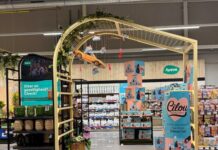
Bostik and Montana Colors deserve special recognition. Their booths weren’t just visually striking; they were experiential. These companies demonstrated how intelligent, emotionally resonant marketing can cut through the noise and engage decision-makers at the deepest level.
As the summit drew to a close, the big question lingered in the Lisbon air: did we rise to the challenge of redefining DIY for a global future? The answer? Partially.
The blueprint was laid out. Some took bold steps forward. Others hovered cautiously near the shoreline. But the sea has been stirred.
Lisbon 2025 will be remembered for its stunning backdrop and warm hospitality also as the moment when our industry was asked to stop competing and start rethinking its value proposition. When it was challenged to trade the red ocean of uniformity for the blue ocean of sustainable added value.
In the port of Amsterdam…
The Queen of the Sea has shown us the way. Now, it’s time to sail to the North, towards the next moonshot, and prepare for the 12th Global Summit in Amsterdam.