Our colleague Thierry Coeman tells us how the Belgian DIY Trade Fair theme highlights the human factor.
Over the years, trade fairs have evolved from pure sales platforms into genuine meeting places, supported by wellthought- out marketing strategies.
A strong overarching theme often serves as the foundation for a complete professional experience, including an extensive seminar programme.
This was also the case at the biennial edition of DIY-Pro- Garden, Belgium’s leading trade fair for the DIY sector, held in Kortrijk, West-Flanders.
To strengthen the theme, the organisers commissioned a qualitative study (NIQ-GfK) to assess how ready the different stakeholders are to embrace technology at an accelerated pace. At the same time, a proof of concept was tested in two well-known retail stores, demonstrating in real-life conditions how technology can streamline and improve in-store processes.
Welcome Mr. B to DIY
Until recently, robotics in retail was often perceived as a technological gimmick. Early application, mainly limited to hospitality and entertainment, sparked curiosity but offered little operational value. Robots welcomed customers and attracted attention, yet rarely contributed structurally to store processes or sales optimisation.
That phase is now clearly behind us. Rapid developments in robotics, artificial intelligence and data processing have given rise to a new generation of retail robots that operate as fully fledged, multidisciplinary tools on the DIY store floor.
In an environment marked by increasing complexity, rising costs and a structural shortage of qualified retail staff, robots are becoming a crucial component of the operational model for DIY retailers.
Not a Replacement, but a Reinforcement of the Human Factor
A key principle is that robots are not designed to replace store employees, but to support and strengthen them. Especially in DIY retail, where expertise and advice play a decisive role in the customer journey, the human factor remains indispensable. Robotics acts as an assistant: an extension of the employee, taking over repetitive tasks, collecting data, overseeing store operations with an eagle eye and guiding customers more efficiently towards the right information or solution.
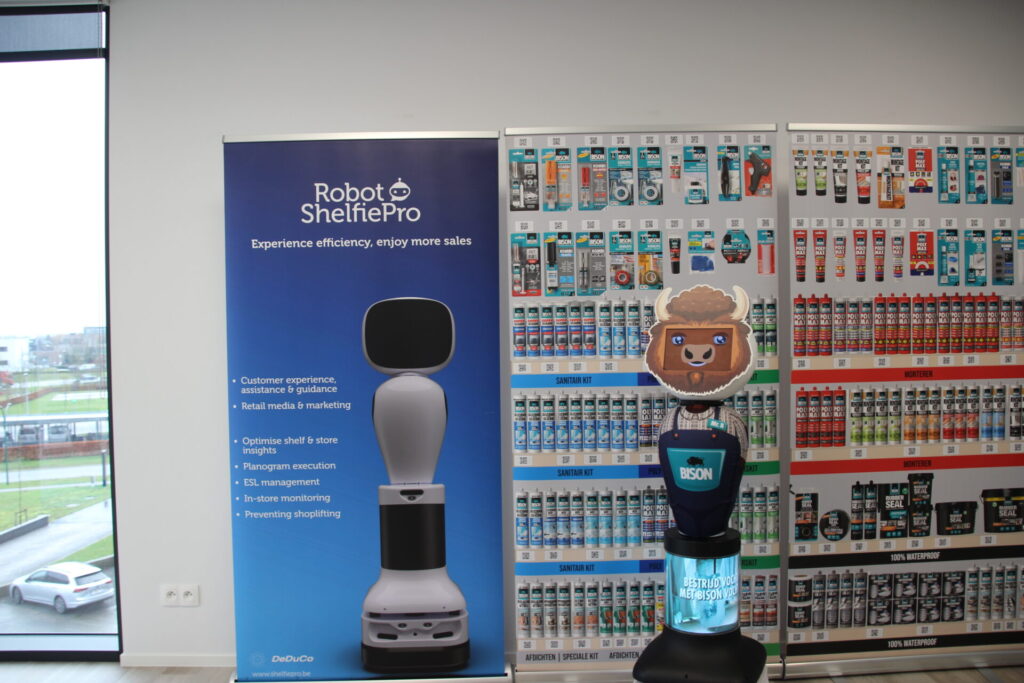
“The robot, nicknamed Mr. B. – engineered in Belgium – and recently deployed over eight weeks at Hubo Heeren in Zonhoven (12,000 m²) and Brico Plan It in Ternat (14,000 m²), currently fulfils seven clearly defined functions,” explains Tom Dujardin, co-founder of DeDuCo, Benelux market leader in CRM and retail robotics.
These include:
– continuous monitoring of product availability
– guiding customers to the correct product location
– mobile marketing communication on the shop floor
– analysing planogram execution and shelf compliance
– interaction with electronic shelf labels (ESL)
– a preventive role in theft-sensitive areas
– supporting field marketers and merchandisers in planogram implementation.
These functions sit precisely at the intersection of operational efficiency and customer experience, two domains where DIY retailers must differentiate today.
Data as the Foundation of High-Performance Robotics
The true strength of retail robotics lies not in the hardware itself, but in the data it generates, analyses and activates. In particular, shelf management and price consistency have a significant impact.
Incorrect price indications are not only legally problematic; they also directly undermine consumer trust. Numerous studies show that price inconsistencies rank among the most common frustrations for shoppers.
This insight was confirmed by the D.A.T.A. study (“Accelerating Technology Adoption in DIY”) conducted by NIQ/GfK and presented during the 36th edition of DIY-Pro-Garden. The study highlights the importance of enriching clean, reliable data quickly, both on the retail side and among suppliers.
“Smart data is no longer a future concept, but an absolute prerequisite,” says Tom Dujardin. “Mr. B is fully integrated into the retailer’s IT ecosystem. Its performance depends not only on the technology itself, but above all on the quality of the data and the expertise of suppliers who provide and optimise that data.”
As a final added value, Mr. B even goes beyond its technical role by acting as a convincing brand ambassador within the category, underpins Martijn van der Sluijs, marketing manager Benelux, Bolton Adhesives.
Concrete Advice at the Right Moment
In DIY retail, customers often visit the store at a critical moment in their project journey: right in the middle of a job, when they encounter a problem. The need for reliable, practical and immediately applicable advice is particularly high.
Martijn van der Sluijs illustrates this with a familiar example: “DIY customers often come in with very specific questions. For instance, when installing a mirror inside a built-in bathroom: which adhesive is most suitable? In such cases, the robot application acts as a first advisor and guides the customer towards the right choice.”
This support is far from redundant. “Independent studies show that today, four out of ten customers leave the DIY store with the wrong adhesive or sealant,” Martijn continues. “That leads to frustration, returns, complaints and reputational damage. Correct advice is therefore crucial, and that is exactly where the robot is purposefully programmed to help.”
Beyond the Proof of Concept
What this evolution makes clear is that robotics in DIY retail has moved beyond the experimental phase. Robots are no longer deployed “because it’s the future”, but because they demonstrably contribute to productivity, data quality, customer satisfaction and ultimately sales.
Stijn Heeren, Hubo franchisee, is convinced: “This test has clearly shown that investing in technology already provides us with a strong competitive advantage today. It is a step-by-step process in which the entire store infrastructure must be carefully aligned to get the best out of the robot.”
For professionals in retail, supply chain and brand manufacturing, this is an important conclusion. Robotics does not require a stand-alone implementation, but an integrated approach in which technology, data, store processes and supplier knowledge come together. Further tests are currently under negotiations, involving several brand manufacturers operating across different product categories. The objective is twofold: to generate additional smart data while simultaneously enhancing brand visibility.
Those who succeed in doing so take a clear step towards a future-proof DIY business model.
Harmonising Tech and Human Touch
Beyond the innovations on the DIY store floor, the seminar programme at DIY-Pro-Garden also offered room for broader reflection. Because technological progress does not only create operational opportunities, it also raises a more fundamental question: how do we preserve the human dimension in an increasingly automated world?
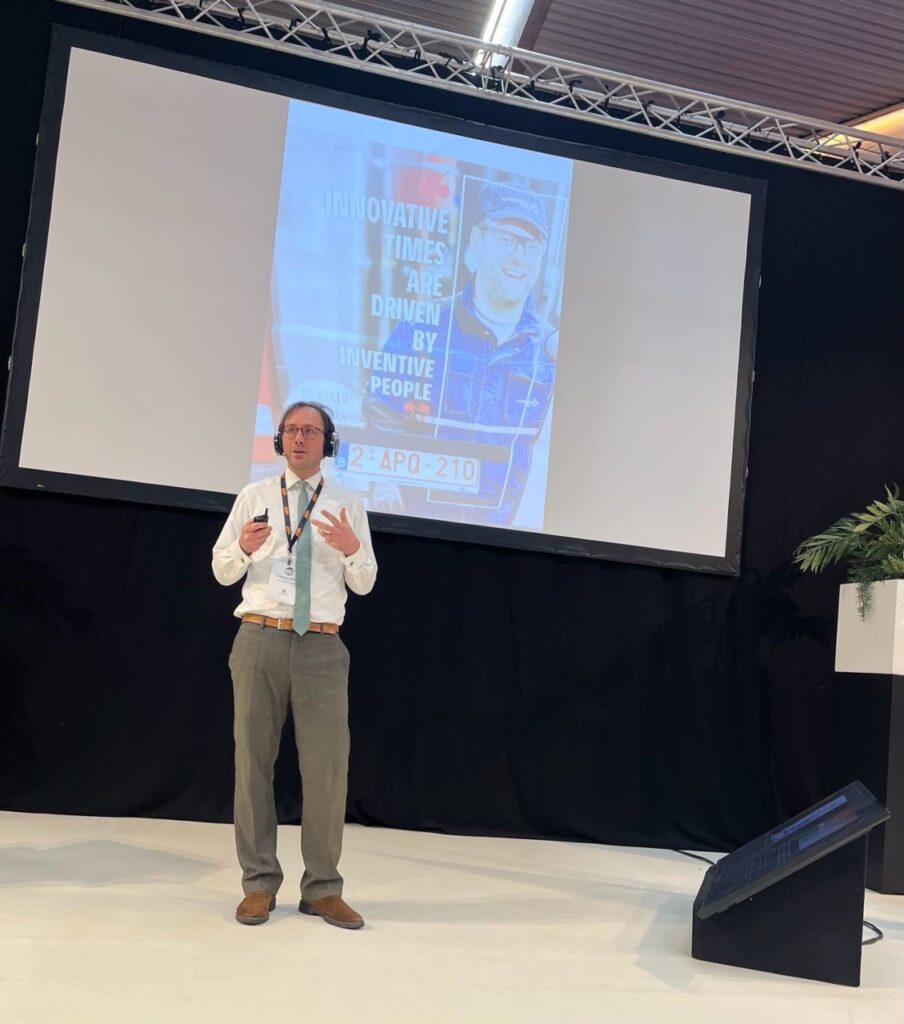
In his keynote Harmonising Tech and Human Touch, Pieterjan Bonne, Lecturer at Artevelde-Antwerp University, emphasised that future-orientated retail is not solely about optimising processes, but equally about trust, emotion and human behaviour.
No doubt, we need to embrace technology, but meanwhile the human factor always will make a fundamental difference. DIY retail will remain forever an interactive experience of emotions, trust, social and human values.
As an opening, he referred to Prof. Andrew Scott (London Business School): “As machines get better at being machines, humans must get better at being humans.” Pieterjan Bonne made the message tangible by highlighting the difference between what technology can improve and what truly drives people. “Humans are not purely rational: we carry bias, psychological needs and expectations”, he stated. Technology will undoubtedly move DIY to the next level, but soul still moves people. “Innovative times are driven by inventive people.”