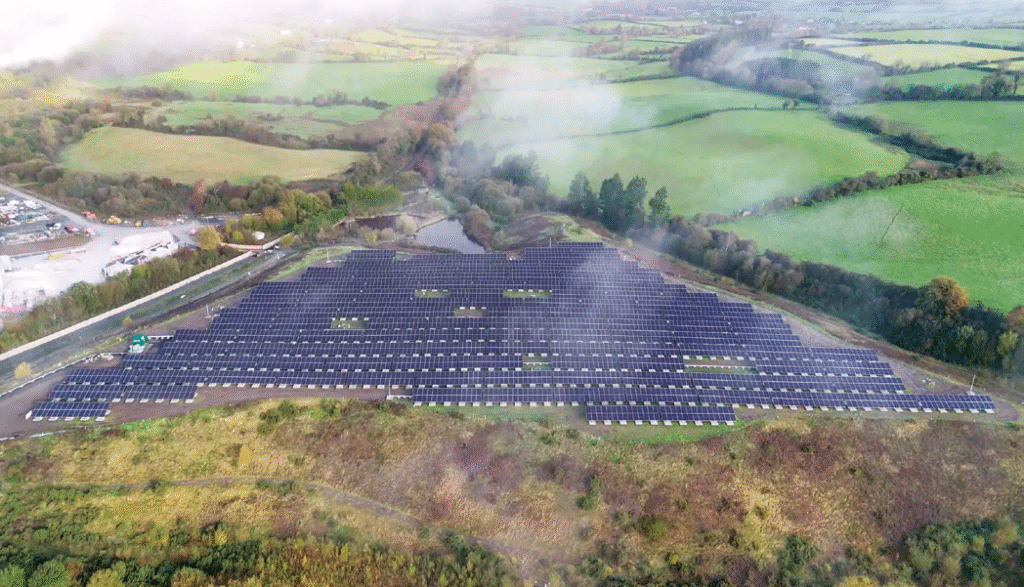
Saint-Gobain Ireland & UK has taken a major step toward its carbon neutrality goal with the launch of its first photovoltaic (PV) solar farm at the Gyproc facility in Kingscourt, Co. Cavan. This pioneering project, delivered in partnership with Activ8 and SSE Airtricity, underscores their commitment to shaping a more sustainable future.
As a leading manufacturer of plaster and plasterboard products, Gyproc, as part of Saint-Gobain Ireland, has always prioritised sustainability, innovation, and safety. To advance this vision, they installed a 2.5 MW solar farm on a former landfill site, an ambitious renewable energy project that demonstrates how industry can repurpose land for positive environmental impact.
The construction sector faces increasing pressure to reduce carbon emissions and transition to cleaner energy sources. For Gyproc, the challenge was to decarbonise operations while finding a suitable location for a large-scale solar installation without disrupting production.
“This is a big leap forward on our journey to a net-zero carbon future for Saint-Gobain in Ireland,” said John Crosse, Saint-Gobain’s Supply Chain & Circularity Director. “Producing clean, renewable energy, that frees up electricity for the grid, from a farm that is clearly visible on our own land is a proud moment for our team and a clear demonstration of our commitment to sustainability.”
The new solar farm will supply approximately 15% of the facility’s total electricity needs, significantly reducing reliance on non-renewable energy. This initiative reflects Saint-Gobain’s purpose of “Making the World a Better Home” and their determination to lead the way in creating a greener, more sustainable future.
Speaking of the partnership Martin Mulholland, Director of Commercial Operations at Activ8, said: “Saint Gobain’s passion for sustainability challenged us to think differently about how renewable energy could be delivered on this site. Working in partnership with SSE Airtricity, we’re extremely proud to have designed and delivered a solution that transforms previously unusable land into a productive renewable energy asset, a first of its kind for us and a strong example of how collaboration can accelerate decarbonisation.”