Why Insulation Isn’t Just to Warm Homes
When discussing insulation with customers, it’s natural to focus on lower heating bills and improved comfort during colder months. While these remain important benefits, insulation also plays a key role in maintaining comfortable indoor environments year-round, supporting healthier homes, improving fire performance and reducing noise transfer.
As building standards evolve and customer expectations increase, understanding these wider benefits can help merchants offer more informed advice and added value.
Avoiding overheating As our climate gets warmer, overheating is becoming a significant design consideration. Contrary to conventional wisdom, high levels of insulation and airtightness are not significant factors for overheating. Just as it helps keep homes warm in the winter, insulation limits heat transfer in the summer, but this needs to be combined with sufficient ventilation and strategic design of glazed areas.
Technical Guidance Document F helps determine the level of ventilation needed to maintain reasonable indoor temperatures. Passive cooling measures, such as external shading and well-positioned glazing, can also significantly reduce overheating. Mechanical cooling systems may still be required in some buildings, but their efficiency and running costs can be improved when the building fabric performs effectively.
Improving indoor air quality
Indoor air quality is increasingly recognised as a major factor in occupant wellbeing, with mould one of the most common signs of poor indoor environments. Mould growth is often caused by condensation.
A continuous layer of insulation, installed correctly and combined with effective ventilation, can help reduce this risk by maintaining warmer internal surface temperatures during colder months.
It is also important to consider how some construction products release volatile organic compounds (VOCs), which may contribute to irritation and discomfort for occupants. Knauf Insulation’s glass mineral wool products use ECOSE®, a plant-based binder that is low-carbon and low-VOC. As a result, the range has achieved the Eurofins Gold Certification for indoor air quality.
For merchants, low-VOC products provide an additional point of differentiation as homeowners become more aware of the relationship between building materials and wellbeing.
Simplifying fire safety
In 2024, Technical Guidance Document B was updated to expand the definition of high-risk buildings and provide additional guidance on the use of non-combustible materials in façades.
The document also states that combustible cladding frameworks and combustible thermal insulation used in over-cladding systems may present a fire risk. For buildings of any height or use, appropriate consideration should therefore be given to material selection.
Using non-combustible materials throughout can simplify specification, while also providing reassurance for insurers, building owners and occupants.
Euroclass Reaction to Fire classifications are used to assess how products contribute to fire spread, smoke production and production of flaming droplets. Ratings range from Euroclass F, which is easily flammable, to Euroclass A1, which is non-combustible.
Glass mineral wool and rock mineral wool insulation products typically achieve a Euroclass A1 reaction to fire classification while also providing thermal and acoustic benefits. However, merchants should always advise customers to check the classification of individual products, as ratings can vary. Providing clarity around fire classifications and compliance requirements can help merchants support more informed specification decisions.
Acoustic insulation in a noisier world
Noise pollution is becoming a growing concern as homes are built closer together and urban areas become more densely populated. Increased rainfall and more extreme weather events are also contributing to higher background noise levels.
This has increased the importance of acoustic insulation in residential construction. Mineral wool insulation is particularly effective because its fibrous structure helps absorb airborne sound waves and reduce sound transmission through separating walls, floors and partitions.
There is a common misconception that only rock mineral wool delivers effective acoustic performance. In fact, glass mineral wool can achieve comparable acoustic results, while also being easier to handle and install in many applications.
For merchants, products that combine thermal efficiency, acoustic insulation and non-combustibility can simplify specification choices and help customers meet multiple performance requirements with a single solution.
Supporting year-round conversations
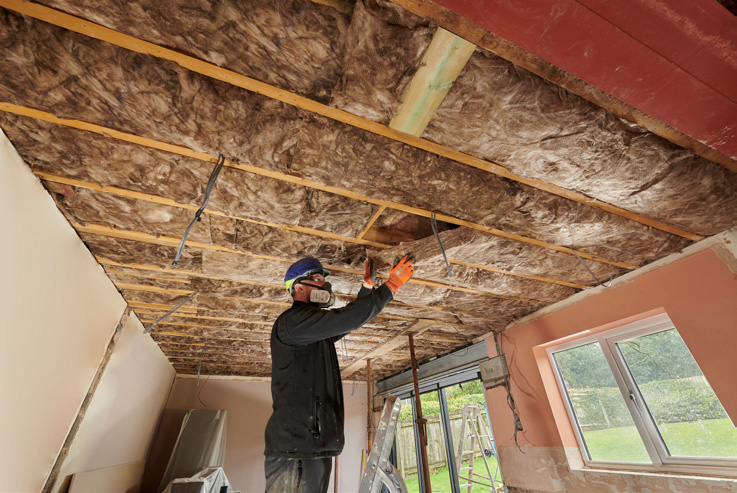
Insulation should no longer be viewed purely as a winter product. From managing overheating and improving indoor air quality to supporting fire safety and reducing noise transfer, insulation plays an important role in creating safer, healthier and more comfortable homes throughout the year. By understanding these wider benefits, merchants can position themselves as trusted advisors and have more valuable conversations with customers in every season.
Visit www.knauf.com for further information.
Fabric First Design: The Smartest Way To Improve Energy Efficiency
As energy efficiency standards continue to evolve, builders are under increasing pressure to deliver homes that achieve higher levels of thermal performance while maintaining cost effectiveness and buildability. Meeting today’s energy performance targets is no longer simply about adding more insulation or incorporating renewable technologies. Instead, the greatest gains come from adopting a fabric first approach, prioritising the performance of the building envelope to minimise heat loss from the outset.
Central to this approach is careful attention to detailing, particularly at junctions where thermal bridging can significantly undermine overall performance. Even in well insulated buildings, heat loss frequently occurs where continuity of insulation is interrupted. These thermal bridges increase heat loss, reduce occupant comfort and can contribute to condensation and mould.
Lintels are one of the most overlooked contributors to thermal bridging. Positioned above window and door openings throughout a building, they represent multiple junctions where thermal performance can either be maintained or compromised. While each lintel may seem insignificant, their cumulative impact across an entire dwelling can influence overall energy performance and Building Energy Rating (BER) assessments.
A successful fabric first strategy considers every component within the building envelope and how those components work together to help reduce heat loss. This means specifying products that actively support thermal continuity rather than relying on additional insulation or mechanical systems to compensate for weaknesses in the building fabric.

One piece thermally efficient lintels are designed specifically with this objective in mind. Unlike traditional multi part lintel arrangements, which can interrupt insulation continuity and create additional thermal bridges, a one-piece design helps maintain a more consistent thermal envelope around window and door openings.
Improving junction details through the specification of thermally efficient lintels can reduce heat loss calculations used within BER assessments, supporting improved Building Energy Ratings. Importantly, this is achieved by enhancing the building fabric itself rather than increasing dependence on renewable technologies or more complex heating systems.
Selecting thermally efficient structural components also provides long term value. They require no maintenance, consume no operational energy and continue delivering performance benefits throughout the lifetime of the building. For contractors, one-piece lintels can also simplify installation by reducing the complexity associated with multiple component systems.
As expectations for energy efficient housing continue to rise, fabric first thinking remains one of the most effective strategies for delivering homes that perform as intended. By reducing thermal bridging and improving thermal continuity, one-piece thermally efficient lintels represent a simple specification decision that can make a measurable difference to energy performance, helping builders deliver homes that are ready for both today’s standards and tomorrow’s demands.
Find out more about Keystone’s Hi-Therm+ Lintels at www.keystonelintels.com