DIY retail isn’t changing. It’s already changed!
Our great friend and regular contributor Thierry Coeman is retiring from his writing duties with The Hardware Journal after many thought provoking and innovative articles over many years. He has however left us a parting gift, a follow up to his initial critically acclaimed Hammertime Publication, we
now have Hammertime².
We have asked Elisa Servais, PhD., RDI, a retail design expert based in Belgium with 19+ years of practice in Shanghai, London and Brussels, to give us an overview of same with some of her own research included and referenced to complement the learnings.
While most retailers in our sector were busy fighting a price war, customer expectations evolved, diversified and intensified. With instantaneous access to a world of information and solutions, they now expect much more from physical stores than reliable (enough) products at a fair price. DIY retailers who wish to remain relevant and, more importantly, future-proof should acknowledge this and act now.
This is the opportunity statement and call at the core of Hammertime!, Thierry Coeman’s white paper based on his extensive industry specific expertise. It also perfectly aligns with my own academic research on “the value of in-store experiences”. In this article, I wish to share with you key lessons from Hammertime! as well as my own PhD, going from theory to practice, and placing them specifically in the context of the DIY and Home Improvement sector.
A new role for the physical store
Historically, customers had no alternative but to visit physical stores to purchase products. For the longest time brick-and mortar shops thus served the sole purpose of stocking and displaying products; at best assisting customers to choose between comparable options.
In the new omnichannel norm, this approach is no longer viable. Why would customers make the effort of going to a physical store if they can achieve the same result from the comfort of their own home? There is simply no denying that online platforms now offer the most convenient option for price and product-focused shopping.
Where does this leave the physical store? For some time, the retail sector feared online would simply kill offline. Thankfully, these projections have been proven wrong as customer research consistently shows that consumers still wish to shop in physical environments. They simply expect something different from
these: something online cannot offer.
Simply put physical stores need to shift their purpose to offer complementarity with what other channels are doing. Indeed, financial success for the entire company can only be achieved when its various channels stop competing, or worst cannibalising each other, and instead work cohesively towards the same value creation objective.
Practically, what does this mean for DIY retailers? It is time to review retail strategies and ways of working.
Placing customers at the centre
The first step in this journey is understanding their target customers. Gone are the days of the one customer profile, that happy, savvy and willing home improver. The scope of DIY knowledge and willingness is much broader today. And it is impacted in part by personality and in part by motivation.
The same customer may actually approach various DIY tasks completely differently. They may for some tasks be willing to work independently (e.g. changing a lightbulb), for others they might prefer to be assisted (e.g. tiling) and for others yet, they may wish to work collectively (e.g. learning to build a cabinet).
The potential customer journeys to conceptualise a store experience around are thus much more varied today. DIY retailers aiming to remain relevant will need to begin their new strategy journey by studying and framing their targeted market to identify and prioritise key shopping missions. The goal should always be to anchor the projected customer journeys into specific and, where possible, individual realities.
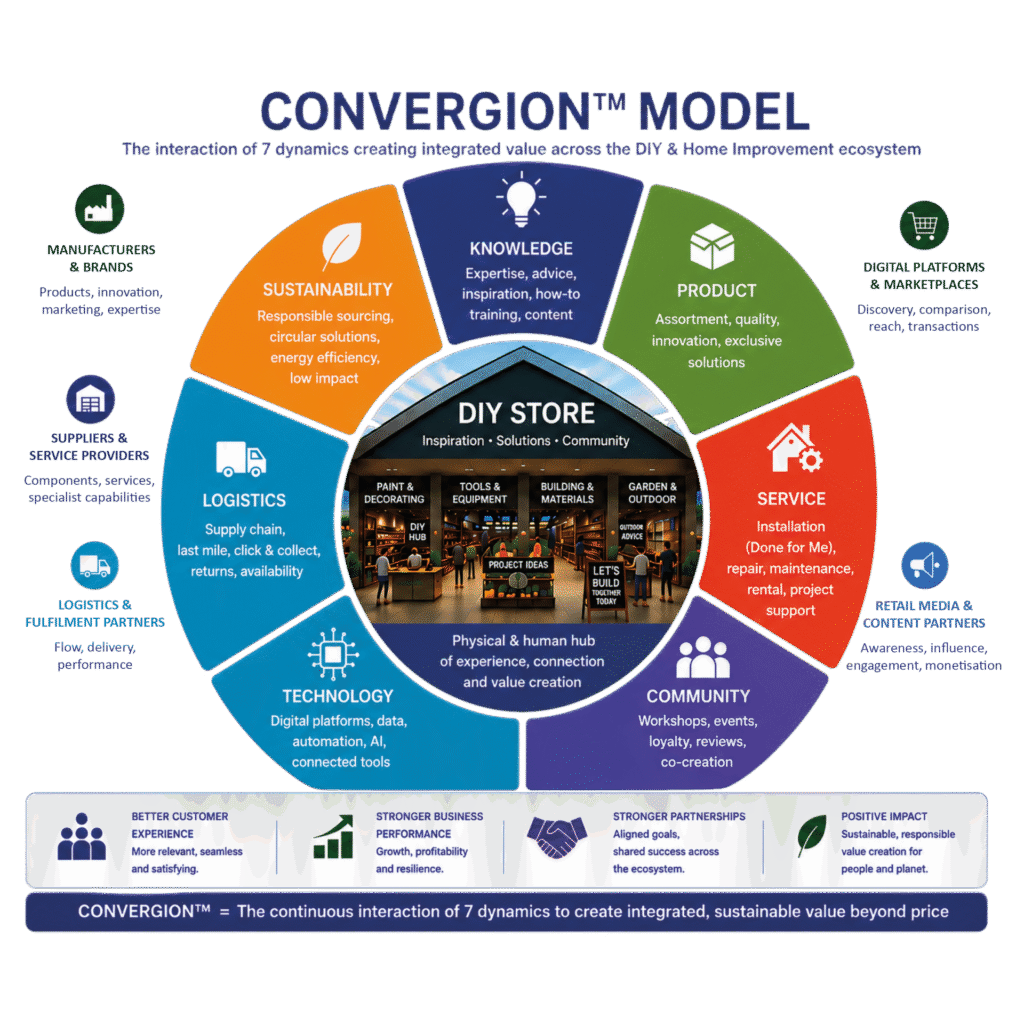
The Convergion model – a tool to rethink the entire value chain
This focus on the customer is essential to guarantee the value chain. After all, it is widely accepted in marketing research that customer value generates value for the retailer and in turn for all its associated partners. Hammertime! rightfully invites our DIY sector to design the store of the future as a value engine. One where silo thinking is forever banished. Instead, all key aspects contributing to the delivery of a valuable customer experience should be integrated from the start: knowledge, product, service, community, technology, logistics and sustainability.
This last point deserves a note. Indeed, the retail industry went through an existential crisis some years ago and “sustainability” became a buzzword for some time. Today we no longer hear it as much, which raises the questions: have sustainable practices become so mainstream they no longer require mention? Or has the “fad” died down? The future of our planet and society certainly hope for the first. As an academic, I can only remind the reader that to close the loop of the value chain we must include the world and society at the end. Only when value is available throughout the world and society are customers able to consider value creation for themselves.
Playing to the physical store’s strengths
In the Convergion Model, as in my own research, we see that it is essential to generate value through elements which are unique to physical environments. Of course, there is the multisensory dimension which other channels have not yet been able to replicate. The physical store remains at the moment the only channel able to offer a fully immersive 360° experience for customers to enjoy and connect with a brand.
But more importantly, there is the human factor. All the research has shown that customers seek genuine human interactions when visiting physical stores. Sadly, what we currently witness is a drop in service quality throughout the retail industry; the exact thing customers are seeking. DIY retailers should consider carefully how they can re-dynamise in-store interactions and once again meet their targeted customer expectations.
Collaborations, collaborations, collaborations
One necessary shift in processes is the revision of partnerships. Whereas before DIY retailers and their suppliers focused on negotiations bringing themselves the most value, they must now focus on the shared objective of co-creating value for the customer. Only then will they truly benefit long term.
This review of partnerships also concerns offer curation and management. There should no longer be competition between private labels and partner brands. Replications should be avoided and instead a coherent brand architecture designed.
And beyond the product offer, careful consideration should be put on service offerings. The end goal should always remain to deliver a seamless customer journey from the moment the consumer becomes aware of his/ her need or want all the way to the moment of use. This will require close collaborations with a myriad of partners sharing a clear shared vision and mission.
This is where data and tech become assets. Not customer facing, but instead to streamline that (preferably human-based) seamless customer service delivery.
Bringing it back to the ground
A key strength of Hammertime! is how it brings the above theory to the reality of practice. The white paper offers many relatable applications and also closes with my favourite part, the below list of priorities for management teams to begin implementing the Convergion Model:
- Move beyond functional silos
- Rebalance KPIs around customer value creation
- Strengthen retail-supplier collaboration
- Invest in operational capabilities
- Empower store and field teams
- Encourage experimentation and reinvention
My own key takeaways
Though I genuinely love this list, as an educator, I personally like to leave my audience with questions to initiate critical reflections. Allow me to thus launch you on your own DIY “re-convergion” with the following:
- Are you clear enough on your brand identity?
- Are you sure you know and understand your target customers? Not necessarily the ones who shop with you now but those whom you wish to shop with you in the future.
- Based on the above, which channels should you be operating? And more importantly: which complementary purpose should each serve?
- Looking more specifically at the physical store:
- how can you craft a product and service offer which meets your target customers’ expectations of a visit to YOUR store specifically?
- and how can you rethink your existing partnerships or find new ones to guarantee value creation for your target customers through a seamless customer journey?
Wishing you a constructive and successful re-Convergion. A free copy of Hammertime! is available to the first five readers to contact editor@hardwareassociation.ie

Elisa Servais, PhD., RDI, is a retail design expert with 19+ years of practice in Shanghai, London and Brussels. She has also spent 8+ years in academia researching and teaching this specific discipline. Her doctoral thesis aimed to gain a better understanding of valuable in-store experiences, with a special focus on gathering insights to better design these. She currently offers various consultancy services as means to share her passion and expertise and call for a more strategy-driven, holistic, omnichannel, collaborative and (neuro-)inclusive approach to retail design practices with as wide an audience as possible. elisaservais.com