How thoughtful signage can guide customers naturally while bringing your brand personality to life.
This article explores how thoughtful retail communication can improve customer flow, navigation and the overall store experience in independent hardware retail. If customers constantly have to ask where something is, there is usually an opportunity to improve in-store communication.
Good retail communication is not simply about adding more signs. It is about creating a clear hierarchy that helps customers move confidently through the environment while expressing your business’s personality.
Retail communication is not just functional; it’s an opportunity to bring your brand to life in-store.
Building a Retail Communication Framework
When we begin a retail design project, we first look at the client’s brand, their customers, and how people naturally move through the store. The goal is to create a retail environment that feels intuitive to navigate and reflects the business’s personality. This becomes the foundation for the retail communication framework.
The most effective stores communicate on three levels: high-level, eye-level and buy-level signage. Each layer helps customers navigate, explore and purchase with confidence while consistently reinforcing the brand throughout the store.
Most importantly, your tone of voice (what your signage says) and brand values (what your brand stands for) should remain consistent across every in-store touchpoint. Whether your business is expertise-led, community-focused, or more conversational, the signage should feel aligned with the brand’s personality. That consistency does two things.
- It builds familiarity, trust and a stronger customer experience from the moment people walk through the door.
- It creates a design language that customers can ‘decode’ so they can easily navigate the signage in store.
High-Level Signage: Helping Customers Navigate
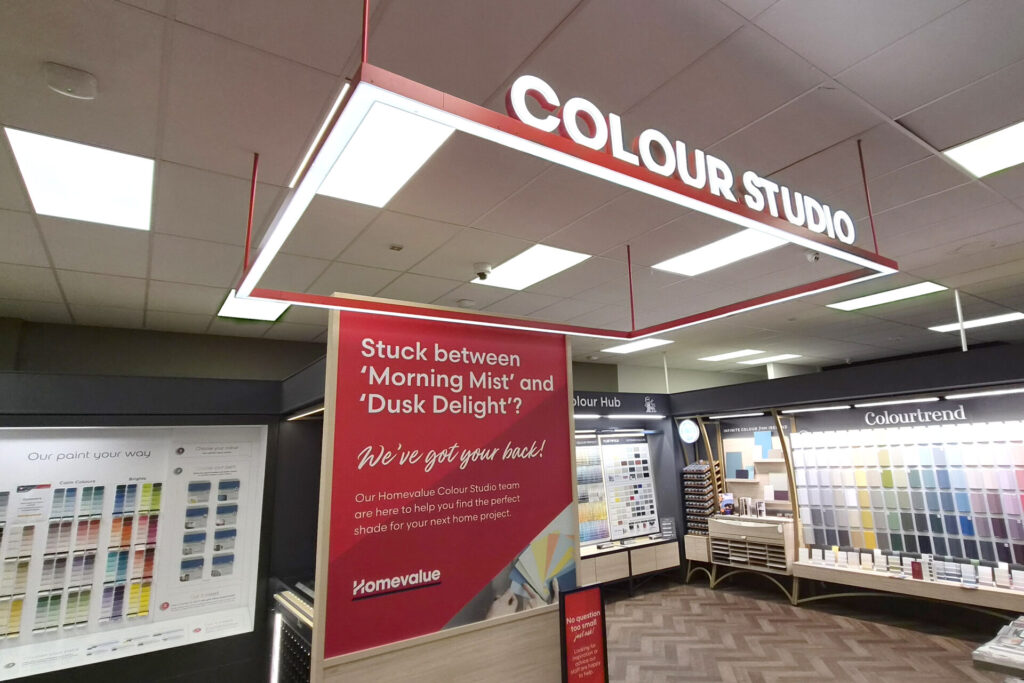
High-level signage sits above head height and is visible throughout the store. Its role is to help customers immediately understand the store’s layout.
This is the first layer of communication customers encounter when they walk through the door.
Typical examples include:
- TOOLS
- PAINT & DECOR
- TIMBER
- GARDEN CENTRE
- PLUMBING
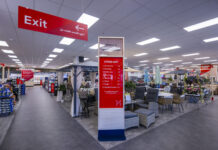
Homevalue stores for example, we designed the overhead department signage to help customers instantly orientate themselves within the space. Large, clear departmental markers allow shoppers to quickly identify key areas and move confidently through the store.
Good high-level signage should be clean, bold and easy to read from a distance. Its role is not to sell products, but to guide movement, create clarity and reduce confusion.
One of the biggest challenges in hardware retail is either too much signage or signage without a clear purpose. When every message competes for attention, customers stop processing the information.
Good wayfinding should feel effortless.
Eye-Level Signage: Where Personality Meets Function
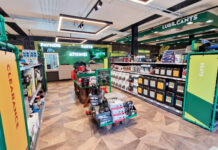
Once customers enter a department, eye-level signage takes over. Positioned within the customer’s line of sight, this layer of communication helps shoppers explore categories, compare products and better understand what is available. This signage is commonly placed on end caps, shelf headers, mid-aisle
displays and product bays.
Typical messaging might include:
- “Professional Grade Tools”
- “DIY Tips”
- “Trade Quality”
- “Staff Recommendations”
- “Need Help? Just Ask”
This is where your retail communication becomes more conversational and customer focused. The signage still serves a practical role, but it also reflects how your business speaks to customers, whether that’s professional, expertise-led, warm or community-focused.
Thoughtful eye-level signage helps customers feel more confident as they browse, while reinforcing the business’s personality throughout the store.
Digital signage can work well here, too, but like all signage, it should have a clear purpose. Whether promoting an event, showcasing staff picks or highlighting seasonal offers, it should add clarity rather than distraction.
When fonts, colours and messaging remain consistent, customers can quickly understand the environment and navigate the store more intuitively.
Buy-Level Signage: The Final Purchase Trigger
Buy-level signage operates at shelf and hand level, where final purchasing decisions are made. This is often the smallest signage in the store, yet it can be one of the most important commercially.
Its role is to help customers quickly compare options and commit to a purchase with confidence.
Typical examples include:
- “Only €9.99”
- “Trade Pack”
- “Waterproof”
- “Best Value”
- “Recommended for Outdoor Use”
At this stage, customers are no longer asking, “Where do I go?” They are asking, “Which one should I buy?”
Clear pricing and product communication are critical here. If information is unclear or hard to find, customers can become uncertain at the final hurdle and walk away without buying. Effective buy-level signage removes hesitation, reinforces value and supports conversion by making the decision process feel
quick and straight forward.
Making It All Work Under Your Brand
Good retail communication does more than help customers navigate a store. When signage, branding and the physical environment work together consistently, they create a seamless retail experience that builds trust and connection with customers.
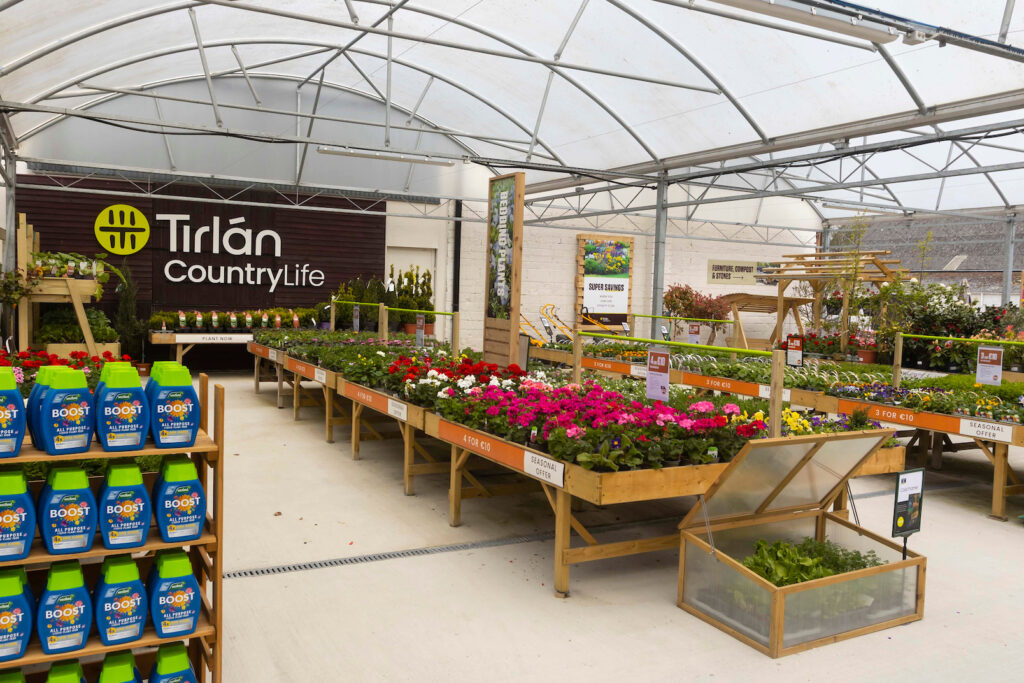
At Tirlán Garden Centres for example, the environment was designed to reinforce the Tirlán brand throughout the customer journey. Wall colours, materials and signage were all designed to reinforce the Tirlán identity throughout the customer journey. Layered throughout the store, high-level wayfinding signage helped customers easily navigate departments, and eye-level messaging reinforced expertise and service. At the buy level, product information panels supported purchasing decisions directly at the shelf.
When these layers work together, the store feels more considered, more inviting and more memorable. That personality is often what keeps customers coming back.

Peter Rigney is Founder and Creative Director of Rigney Forge, a retail design studio based in Co. Westmeath. With experience across hardware, grocery, garden centres and hospitality, Peter and his team specialise in creating high-performing retail environments that combine commercial strategy with strong brand identity. Rigney Forge works with independent and multi-site retailers across Ireland, helping businesses modernise and strengthen their in-store experience through structured, insight-led design. Peter can be contacted at Peter@rigneyforge.ie or visit www.rigneyforge.ie for more information.