Introduction
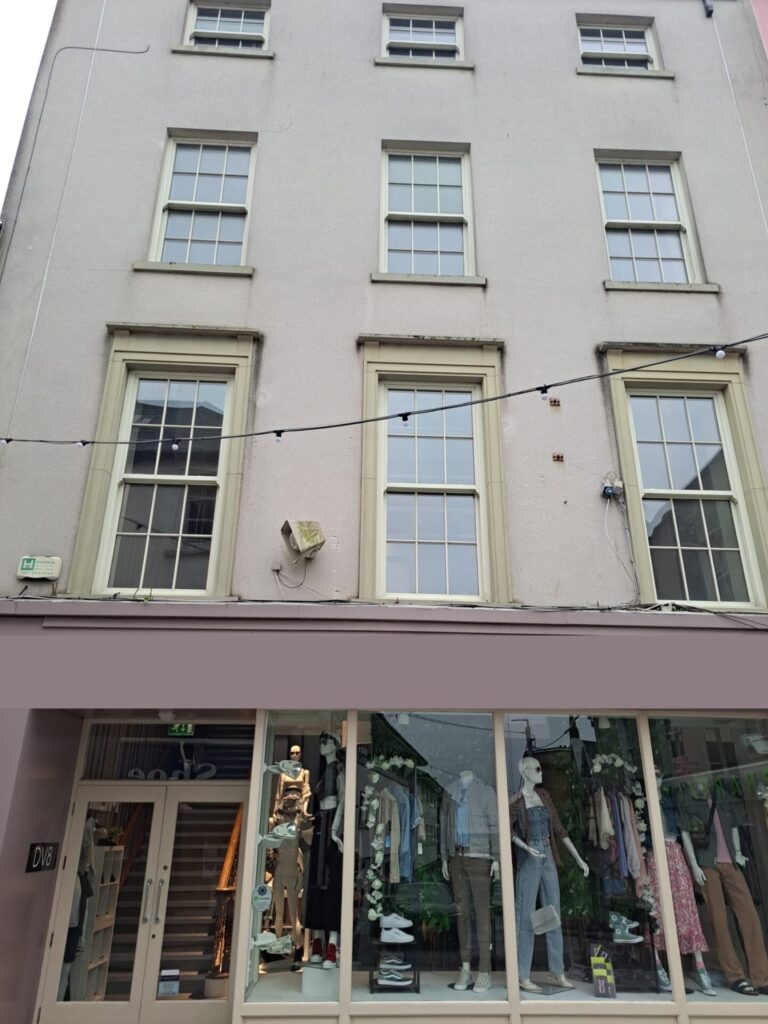
The reuse of vacant “above-the-shop” units in urban centres is now more attractive than ever due to recently expanded grant incentives for owners of such buildings. However, these projects require expert guidance and oversight and should not be undertaken on a “DIY” basis. Prospective developers should engage the services of a competent technical professional to guide them through the process and oversee and certify the works. This should ensure the correct application of fire safety provisions and avoid costly errors.
The Hardware Journal asked Martin Moore, Assistant Chief Fire Officer, Tipperary Fire and Rescue Service to give us his professional perspective.
Legislation
Two primary pieces of legislation apply when considering fire safety in the reuse of “above-the-shop” units, the Fire Services Acts 1981 & 2003 and the Building Control Act 1990 (as amended).
The Fire Services Acts 1981 & 2003 applies to both the commercial ground floor unit and any prospective residential units overhead regardless of the age of the remises. The Act requires that the person in control of the premises ensures “reasonable” fire safety provisions are in place at all times. The Building Control Act 1990 (as amended) legislates for Building Regulations and Building Control Regulations. Building Regulations are the minimum standard that works or a building undergoing works should achieve, such as fire safety. Whereas the Building Control Regulations demonstrate compliance with the Building Regulations. For example, the Fire Safety Certificate application process demonstrates how a building will comply with Part B (Fire Safety) of the Building Regulations.
Prospective developers should familiarise themselves with these pieces of legislation and obtain competent technical and legal advice to ensure they fully understand their statutory duties should they wish to reuse an “above-the-shop” unit.
Fire Safety Certificate Process for VATSU Reuse
Where it is proposed to reuse the vacant floors above a commercial business as residential accommodation, a Fire Safety Certificate will most likely be required. While most people will be aware of the Planning Permission process, the FSC process is not widely understood. The process involves appointing a competent technical professional such as a fire engineer to prepare a report and drawings detailing how proposed works will comply with fire safety standards. This application is submitted to the Local Authority where Fire Officers will review the application and determine whether the proposed works will comply with the fire safety aspects of Building Regulations. At the end of the process the Local Authority / Building Control Authority certify the design.
Key Fire Safety Considerations
There are six parts to Fire Safety Building Regulations;
- Part B1 – Adequate means of warning and escape.
- Part B2 – Adequate linings to Walls and Ceilings to inhibit fire spread.
- Part B3 – Adequate fire resistance to prevent fire spread through the building.
- Part B4 – Prevention of external fire spread to boundaries and other buildings.
- Part B5 – Adequate access and facilities for fire services.
- Part B12 – Provision of sufficient information on fire safety systems.
All parts will apply to above-the-shop unit reuse, however the key parts that require the most attention are B1 (means of escape) and B3 (fire resistance) as they pose the most difficult issues to overcome.
The first step in any “above-the-shop” unit project is a conditional survey of the existing property. This will inform the number of dwelling units that may be possible along with forming the road map of required works. Prospective developers should be aware that fire safety provisions are lesser for a one dwelling unit above the shop and increase where additional units are proposed due to the need for a protected communal escape route, interlinked fire detection and alarm system and emergency lighting system.
My research in this area has indicated that there are three primary obstacles to “above-the-shop” unit reuse as it pertains to fire safety, namely:
- The separation of the escape route of the flat(s) from the commercial unit:
The escape route from the flat(s) should be entirely independent of the commercial unit. This can pose a problem due to history of this building stock where a stairway was typically located at the rear of the shop providing access to the accommodation overhead for the shopkeeper’s family. A dedicated escape route for the flat(s) via a stairway enclosed in fire-resistant construction leading to a final exit is required, communication through the commercial unit is not acceptable. In some situations, the existing stairway may not be suitable for reuse and a new entrance and stairway may be required to satisfy the escape route from the flat(s). There is a misconception that an external fire escape stairs must always be provided – this is rarely the case. It is more preferable to protect an internal stairway with fire-resisting construction and fire doors to achieve a protected internal escape route. - The provision of fire-resistant lobbies between the escape stairway and the flat:
Where multiple dwelling units are proposed, the communal escape stairway should be provided with a lobby at all levels to minimise the entrance of smoke into the stairways from a fire within a flat. Alternative to a communal lobby is the provision of a protected entrance hallway to each flat. This comprises fire resisting walls and fire doors within the hallway of the flat. However, both the lobby and the protected entrance hallway reduce the available floor area of a prospective flat and owners should take this into account when complying with other pieces of legislation such as the minimum floor areas required for flats under Planning Regulations. - The provision of fire compartmentation between the commercial unit and residential overhead:
The risk of a fire within the commercial unit impacting the residential area must be mitigated through compartmenting the building with robust construction to limit fire spread. Generally, the floor between the commercial unit and overhead residential will need to be upgraded with fire resistance and services within the floor void should be relocated. There are two methods available to upgrade the floor – improve fire resistance from below by installing a fire-resistant layer to the ceiling (i.e. plasterboard) or by lifting the floor boards from above and installing a proprietary fire-resistant product between the floor joists.
The method chosen will need to consider the impact on the commercial unit particularly where it is operational. Documents such as BRE Digest 208 and BR 128 published by the British Research Establishment provide useful guidance on the fire resistance upgrade of existing floors.
Some of these elements may require you to consider compensatory fire safety measures elsewhere which should be discussed and agreed with your local Fire Authority.
Conclusion
The reuse of vacant “above-the-shop” units in urban centres is key to unlocking under-utilised residential accommodation. Fire safety provisions must be at the forefront when considering such a project. With competent technical advice from a qualified professional, the fire safety aspects can be easily incorporated into the project. Inevitably, bespoke solutions may be required depending on the individual peculiarities of “above-the shop” units building stock, however through consultation with the local Fire Authority, solutions can be found.

Martin Moore
MSc., BSc. (Hons), C. Build E MCABE, MIBCI,
Registered Building Surveyor
Assistant Chief Fire Officer, Tipperary Fire & Rescue Service