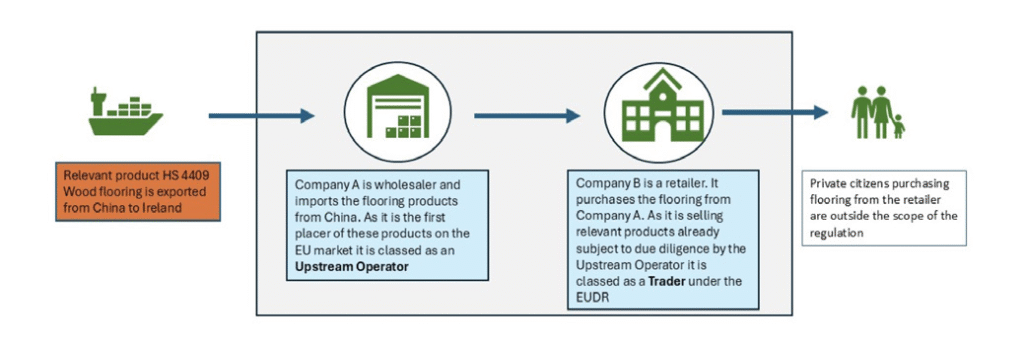
The EU Deforestation Regulation (EUDR) will enter into application on 30th December 2026, with its potential to impact those trading in relevant wood products in Ireland. Key to understanding if and how the regulation applies to your business begins with knowing if the products you’re trading in are covered by the EUDR. The full list of products can be found in Annex I of the regulation which includes wood products such as fuel, wood, furniture, sawn wood, particle board, OSB, plywood, wood flooring, and sheets of veneer.
If you are trading in these products, then knowing your position in the supply chain can help determine your obligations. If you are the first company in the supply chain to bring the product to the EU market (e.g. by importing from a third country) your company is classified as an “Upstream Operator”. Upstream operators are responsible for carrying out due diligence before placing these products on the market or exporting them from the EU. They must also submit a due diligence statement (DDS) with key product information to the EUDR’s online Information System. In the case of imports and exports, a DDS reference number or exemption code will be required on the customs declaration to demonstrate compliance with the regulation.
Those trading in relevant wood products that have already undergone due diligence by an Upstream Operator are classified as a “Downstream Operator” or “Trader”. Downstream operators are usually those who process one relevant product into another and place them on the market or export them. For example, a company buying wood products (HS 4403) from an Operator (who has already conducted due diligence) and processing them into fuel wood briquettes (HS4401). Downstream operators are responsible for collecting and keeping certain information on their suppliers and their buyers for at least five years and notifying competent authorities if they discover that their product might not comply with the regulation. They do not have to carry out due diligence or submit a DDS to the Information System.
However, the first downstream operator, who is the first buyer of a relevant product from an upstream operator is subject to some additional requirements. They must collect and keep a record of the DDS reference numbers passed to them by Upstream Operators for five years. This is a passive role to an extent, as they do not need to ask their supplier for the numbers. The obligation lies with the Upstream Operator to pass these numbers on.
Consumers, for example, private citizens purchasing wood products from a retailer are at the end of the supply chain and do not have any responsibilities under the EUDR.
For more information on how the EUDR applies to you, read the Supply Chain Infographics, the FAQs and the Guidance document, or email eudrwoodproducts@agriculture.gov.ie.
For more information, please visit the European Commission’s website by scanning the QR code or visit www.gov.ie/EUDR or contact eudrwoodproducts@agriculture.gov.ie