In the hardware and builders’ merchant sector, margin pressure is nothing new. Every owner understands the challenges – supplier price increases, wage costs, energy, transport, and finance. When margins disappoint, the blame almost always lands in the same place.
“Bad buying.”
Sometimes that accusation is justified. Poor buying decisions, weak scale, or a failure to negotiate properly will absolutely hurt margin. But in many of the businesses I’ve worked with, buying was not the real issue – or at least, not the whole story.
In fact, one of the most damaging patterns I see is this: a hard-won buying gain is quietly given away at the point of sale, often without anyone realising it is happening. Once that happens, the effort put into negotiating better cost prices becomes meaningless.
Where Margin Is Really Lost
Buying and selling are often treated as separate disciplines. Senior management focuses on supplier terms, rebates, and price lists. Selling, meanwhile, happens at the counter, on the phone, or on site – fast, reactive, and under pressure.
Many management teams don’t fully understand the dynamics of face-to-face selling in a trade environment. What drives the price a customer is willing to pay is rarely just the number on a price list. Urgency, familiarity, trust, availability, service, and confidence all play a role – as does how the product and the business present themselves.
When pricing underperforms, the explanations are usually familiar:
– “The margin is too high.”
– “We’re too expensive.”
– “The customer expects a discount.”
Repeated often enough, these assumptions become accepted truths – even when they are not. Most margin leakage is behavioural rather than strategic, and the pressure is being felt across the sector.
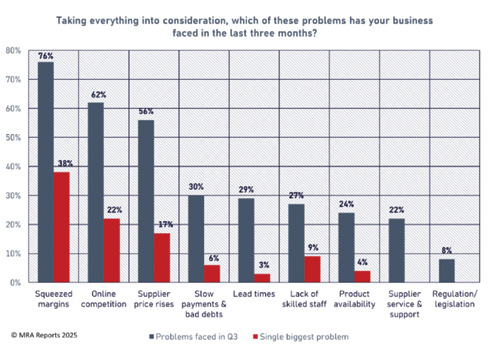
According to research published by MRA Building Market Reports on 10 November 2025, 76% of merchants surveyed identified squeezed margins as their single biggest challenge, ahead of online competition, supplier price increases, and staffing issues. This confirms that margin pressure is not anecdotal – it is an industry-wide reality.
Discounting Without Being Asked
Across most stores I’ve worked in, discounts are regularly given without the customer ever asking for one. Poor store standards often undermine the perceived value of products and the confidence of the people selling them.
In one store, staff insisted customers expected a discount – yet very little was priced. Customers had to ask the price of almost everything. Staff saw what they believed was a large margin, felt uncomfortable charging it, and discounted automatically. A bad discount culture had formed, driven not by customer demand, but by uncertainty.
Life at the trade counter is often misunderstood by those removed from it. Staff sometimes have to deal daily with aggressive, dismissive, impatient and sometimes uninformed customers – usually under significant time pressure.
In one instance, a regular customer intimidated a young staff member by walking behind the counter uninvited, selecting tools himself, and aggressively demanding the “best price”. Despite the shelf prices being very competitive – confirmed later through mystery shopping – the maximum discount was applied automatically. There had been no training on handling awkward customers, no confidence in holding price, and no clarity on acceptable margin. The discount was not strategic. It was defensive.
Behaviour Changes When Visibility and Understanding Improves
Most margin leakage is not deliberate. It is habitual. When staff can clearly see margin, understand what “good” looks like, and feel supported by management, behaviour changes quickly.
Across more than 50 stores, I’ve seen:
– Up to 15% improvement in sales margin with key individuals
– 7%+ margin uplift at organisational level
– Stronger pricing discipline and fewer overrides
– Better customer conversations – not fewer sales
How Do We Stop the Loss?
The solution is not a single price list or system change. It is leadership, training, communication, standards, and reporting working together.
– Training – Structured and In-House
We must stop assuming people automatically know how to sell, price, and protect margin. Years ago, shop apprenticeships existed to teach these skills. Today, many staff are expected to learn by observation alone.
Training needs to be structured, ongoing, and reinforced through regular in-house coaching. Pricing confidence, customer psychology, and handling difficult interactions are learned skills – not instincts.
– Communication and Observation
Leaders need open lines of communication with those at the point of sale. Time spent observing, listening, and asking questions builds understanding and trust. Before criticising discounting behaviour, it is essential to understand the pressures staff face at the counter.
– Store Standards Create Value
Store standards are not cosmetic – they are commercial. Clean, faced-off shelves, visible pricing, stock rotation, and clear margin drivers at the trade counter all reinforce value. When a store looks professional, staff feel more confident charging a fair price, and customers are more willing to pay it.
– Reporting, KPIs, and Recognition
Reporting is essential in supporting and driving margin – but only when it has meaning. Producing reports that people do not understand achieves nothing.
Effective reporting means honest, accurate figures, clearly explained, reviewed weekly and monthly, and followed up. KPIs give people something to aim for. Recognition – whether
financial or simply acknowledging good performance – reinforces the right behaviours.
People protect what they understand.
They improve what they are measured on.
They repeat what is recognised.
Why This Matters in Hardware
Hardware and builders’ merchant businesses are uniquely exposed to margin leakage. High SKU counts, mixed retail and trade customers, long-standing relationships, and constant price comparison mean decisions are made quickly and under pressure.
Without clarity and confidence at the counter, margin is lost one transaction at a time.
The hardware businesses that protect margin best are rarely the cheapest and rarely the biggest. They are the most disciplined. They train their people, set standards, communicate openly, and use reporting as a tool to support – not punish.
Margin is not lost in one bad deal.
It is lost in hundreds of small, well-intentioned decisions made every week.
The good news is this: once you can see it clearly, you can fix it.

Dave Gavin currently works as a business and profitability consultant, he partners with organisations in the merchanting, DIY, retail and supplier sector to strengthen commercial performance. He helps leadership teams understand where value is created, improve margin discipline, and ensure their operating model and workforce are aligned to deliver results. Recent projects include supporting multi-branch groups such as HPC and Core Builders Providers to improve operational efficiency and drive margin growth.
Dave’s approach is grounded in real experience: more than 25 years owning and leading a multi-branch builders’ providers and contributing at industry level through board roles with Homevalue and Hardware Association Ireland. He leads with a people-first ethos – clarity, accountability, and empowered teams.