The Early Mornings and the Endless Weeks
My day used to start at 4am or more accurately, I woke at 4am. My mind switched on by 4:05am. I was afraid to sleep any longer because there was always too much to do. By 5am, I was already running through debtors listing, outstanding tasks and potential problems in my head – panicking because there were never enough staff or hours in the day. Every task felt urgent; every minute mattered.
Looking back now, I realise I was addicted – not to drink or drugs, but to work. It was my comfort, my crutch, my identity. My business was the child I never had – it defined me, it drove me, and it demanded every ounce of energy I had and I loved it!
Learning to Let Go
When I finally decided to let go – to make the business a saleable asset – I had to face a truth I’d long avoided: it couldn’t depend entirely on me.
I had to chip away at the parts of my day that made me indispensable, automate what I could, and build a team that could stand without me. That took time – and a lot of humility.
In the thick of it, you tell yourself there’s no other way. You love the chaos, the purpose, the “busy.” But at what cost? My world had shrunk – fewer friends, little social life, and conversations that always circled back to the same refrain: how busy I was, how hard it was to find staff, how everything depended on me.
The truth was, it didn’t have to.
The Staff Crisis That Never Ends
Currently, I support businesses in growing margin and sales through optimisation of operations and having the independent view after stepping back, I see the same pattern across the country. Managers and business owners overwhelmed, short-staffed, and stuck.
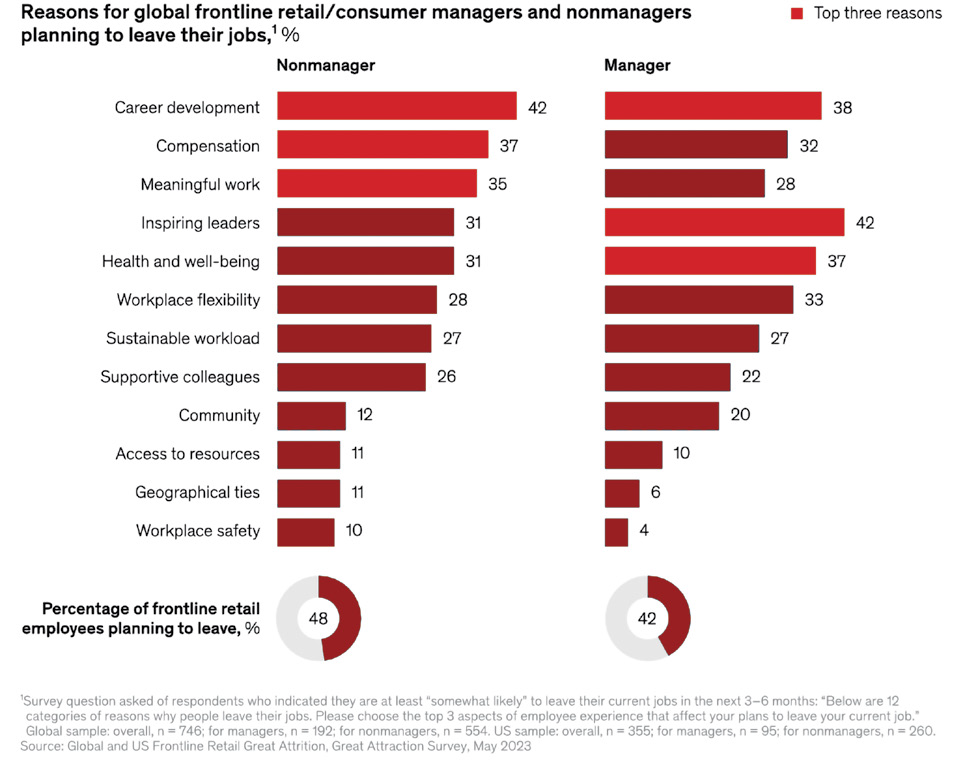
Staff retention remains one of the greatest challenges in retail and building-supply businesses. McKinsey & Company (2022), see graph on previous page, show a mix of causes for frontline retail employees leaving their jobs. Career development, meaningful work, inspiring leaders and health & wellbeing are among the top reasons alongside compensation as the main reasons.
We also face a generational gap. The younger workforce is better educated, more mobile, and less likely to see a trade counter as a career for life. One lad I met had a degree in construction studies – a brilliant qualification – but he felt he was stuck behind a counter with no training plan, no mentor, and no clear path forward. How do we inspire this generation to work with us is the big question.
Training, Mentorship, and Motivation
Too often, the first lesson new hires learn is how to give a discount. That’s the culture we’ve created – price first, value later. Real training is rare. Few have a mentor beside them saying, “Here’s how you serve, here’s how you sell, here’s what each product does.” We’ve lost that apprenticeship style of learning that once made our trade strong. Maybe it’s time to bring some of that back.
And it’s not just about skills – it’s about belonging. People stay where they feel valued. That means giving them structure, feedback, and a sense of purpose – not just a payslip.
Small firms, like mine was, often struggle here. With 15 or 16 staff, I couldn’t offer a promotion ladder. My focus was on automating tasks and survival. But even small steps – 3rd party educational training, better organisation, cleaner layout, clearer systems – made the place easier to work in and boosted morale.
The Manager’s Trap
Sometimes, we are our own worst enemy. When a delivery is late, we jump into the van ourselves. When a customer shouts, we grab the forklift or load the truck. We think we’re helping – but we’re actually teaching our team that we’ll always step in.
I learned that lesson the hard way. When I lost vision in one eye and could no longer drive, I was forced to stop. I told staff and customers, “Sorry, I can’t deliver.” And you know what? We never lost work as with careful planning and clear communication work was completed in a satisfactory timely manner.
That taught me boundaries – and the importance of setting standards. My father always said, “Go to work dressed like you’re meeting the bank manager.” It made me think twice before rolling up my sleeves – and it made the staff think twice before asking me to. More importantly, it showed them that leadership looks different from labour.
Small Business owners and branch managers are often perfectionists. Theycan’t accept less than 100% leading to longer hours, small – med size businesses owners are often the trainer – head of HR – head of sales – chief counsellor – financier. A bank manager once commented ‘if you get someone to stand in for you, they will only do 70% of what you can do.’ Its accepting this limitation and knowing where you can help them grow is key to sharing the workload.
Building Better Workplaces
The little things matter. Clean layouts, organised stores, clear labelling, and smart health-and-safety systems. Not as bureaucracy – but as tools to make life easier for the people at the coalface. Technology can help too – automated stock systems, reorder levels, and smart dashboards that cut time-wasting tasks. Every five minutes saved is five minutes you can spend supporting staff instead of firefighting.
Because at the end of the day, that’s what leadership really is – creating an environment where people can succeed without burning out, and where you, the owner, can finally breathe.
Clear communication and understanding of the process and one’s role is a game changer, shared responsibility and accountability for one’s actions alongside this.
Training is key to staff morale, retention and your ability to share the workload. I met a Lithuanian warehouse supervisor who explained to me in perfect English how his employer paid for his English tuition, and how his team of five were working well with him. What made him feel proudest in his role was that he was a keyholder and was trusted with opening the business every morning!
Coming Out the Other Side
Today, I can look back with gratitude – not regret. The long hours, the exhaustion, the lessons – they all led to a better understanding of what drives small business owners like me. We do it because we care. But caring too much can consume you.
So if there’s one message, I’d share with any business owner today, it’s this: take back your five minutes. Start with small changes. Build systems, trust people, and give yourself permission to let go. Because there will always be just 168 hours in a week – and that will never be enough if you’re trying to do it all alone.
Dave can be contacted at david.gavin@dazo.ie

Dave Gavin currently works as a business and profitability consultant, he partners with organisations in the merchanting, DIY, retail and supplier sector to strengthen commercial performance. He helps leadership teams understand where value is created, improve margin discipline, and ensure their operating model and workforce are aligned to deliver results. Recent projects include supporting multi-branch groups such as HPC and Core Builders Providers to improve operational efficiency and drive margin growth. Dave’s approach is grounded in real experience: more than 25 years owning and leading a multi-branch builders’ providers and contributing at industry level through board roles with Homevalue and Hardware Association Ireland. He leads with a people-first ethos – clarity, accountability, and empowered teams.